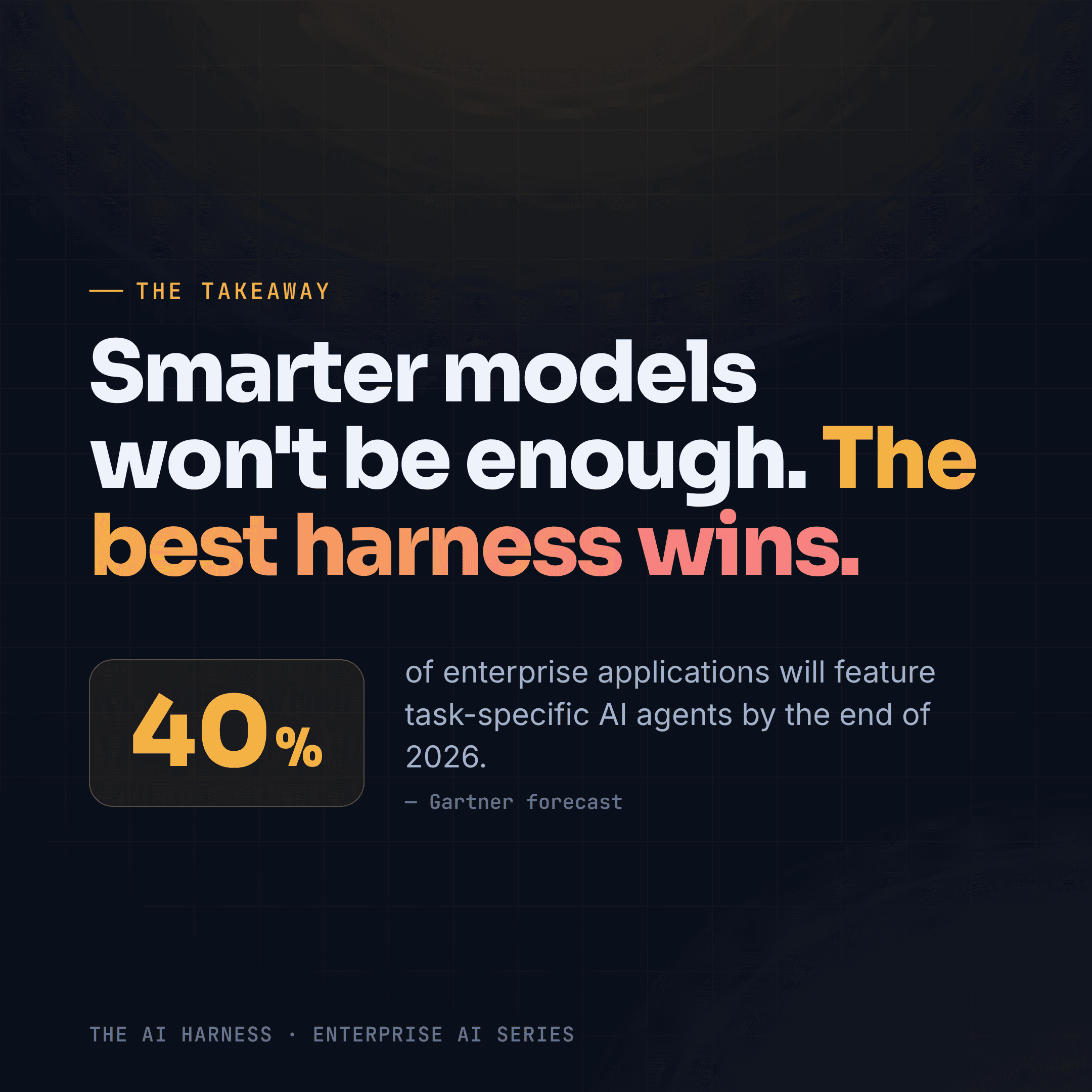
The AI industry is entering a new phase. Since Large Language Models (LLMs) first burst onto the mainstream in 2022 with the introduction of ChatGPT to the wider world, it has felt like the major players in AI were in a race to build better, more powerful models. It was assumed that creating smarter LLMs, trained on more data, with bigger context windows was the key to making AI more capable. Now increasingly, it is the software, tools and infrastructure wrapped around the model, called 'the harness', that is emerging as crucial.
Especially as AI evolves beyond chatbots that simply provide advice and guidance and become agentic systems capable of acting and completing tasks autonomously, the harness is becoming the source of real value. In business, it is being viewed as the key component that will give enterprises the confidence to rely on AI to execute complex workflows effectively, reliably and safely.
One way of understanding the significance of the AI harness is to think of an AI model like Claude, Gemini or GPT as raw reasoning capability or the brain. On its own it has no eyes, no hands, no memory of what it did yesterday, and no constraints on where it can wander. Like a wild horse, it has incredible power, but it goes wherever it wants.
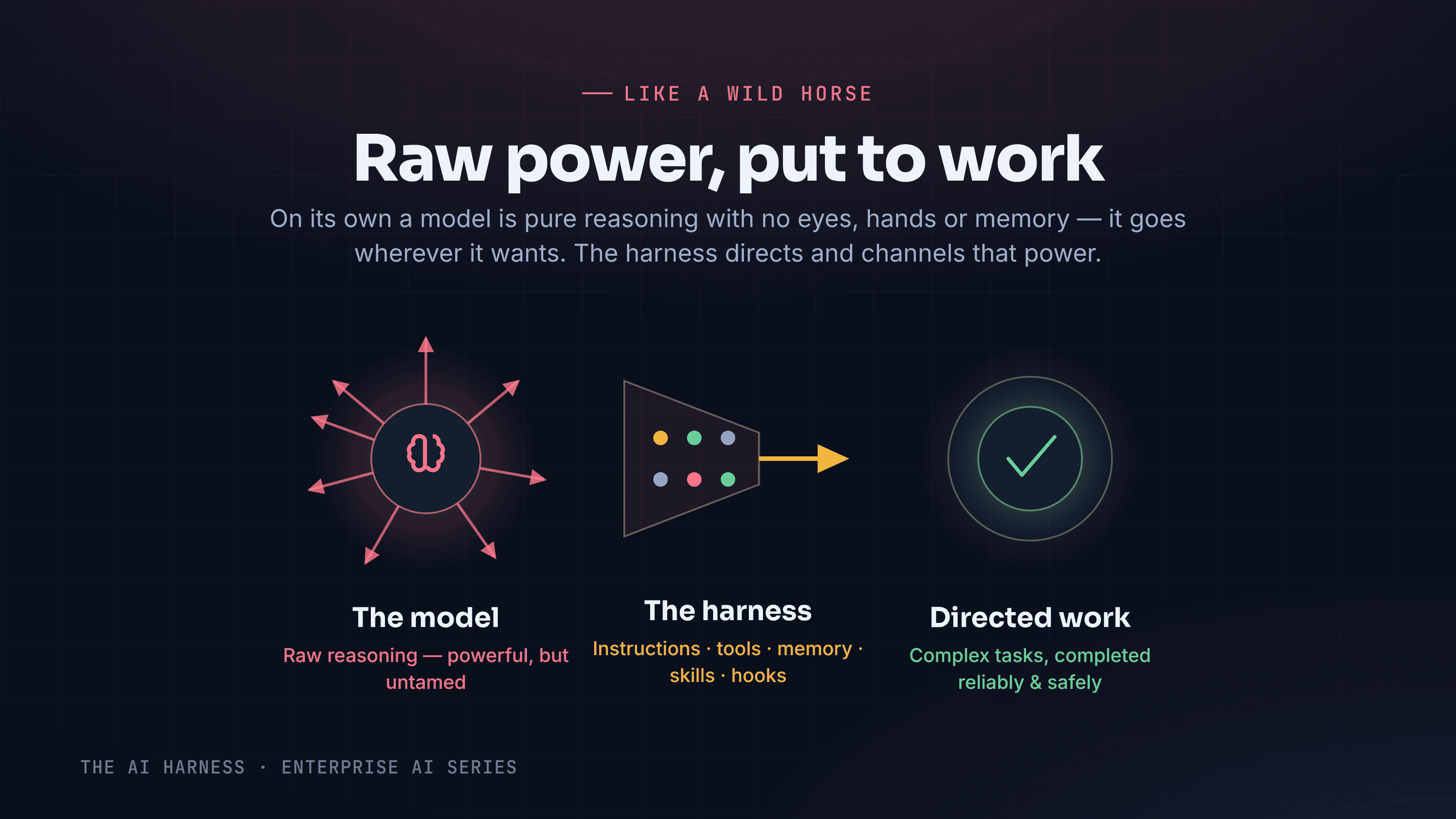
The harness provides the ability to direct and channel that raw AI reasoning power, to put it to work. It includes the instructions, tools, memory, skills, sub-agents and safety hooks that ensure that the wild horse is working for you.
While the terminology is new and still evolving, there has been a growing consensus over the last six months among the likes of OpenAI, Anthropic, Google and the open-source community around the crucial role of the harness and of harness engineering.
Why the harness matters
In the business world, Praveen Akkiraju, the MD of Insight Partners, one of the largest growth-stage investors in enterprise software and agentic AI, told CIOs at a recent interview: "The agent is actually the harness. Combine the model with the harness, give it a set of tools, its context, its memory. That's how you do work."
Increasingly, companies are launching AI agents and applications built by developing powerful harnesses that are not tied to any specific model. Changing the harness can significantly change what a model is capable of doing.
Anthropic has won praise for Claude Code, a powerful AI coding agent which it built by creating an AI harness around its model that it designed specifically for coding. It then built Claude Cowork, another AI agent, this one focused on automating and managing everyday work-related tasks for non-technical business users, by rewrapping the same model with a refined harness and a more user-friendly interface. It is the harness that makes the difference.
Changing harnesses, has, in fact, been shown to make a measurable difference to how models can perform on independent benchmark tests.
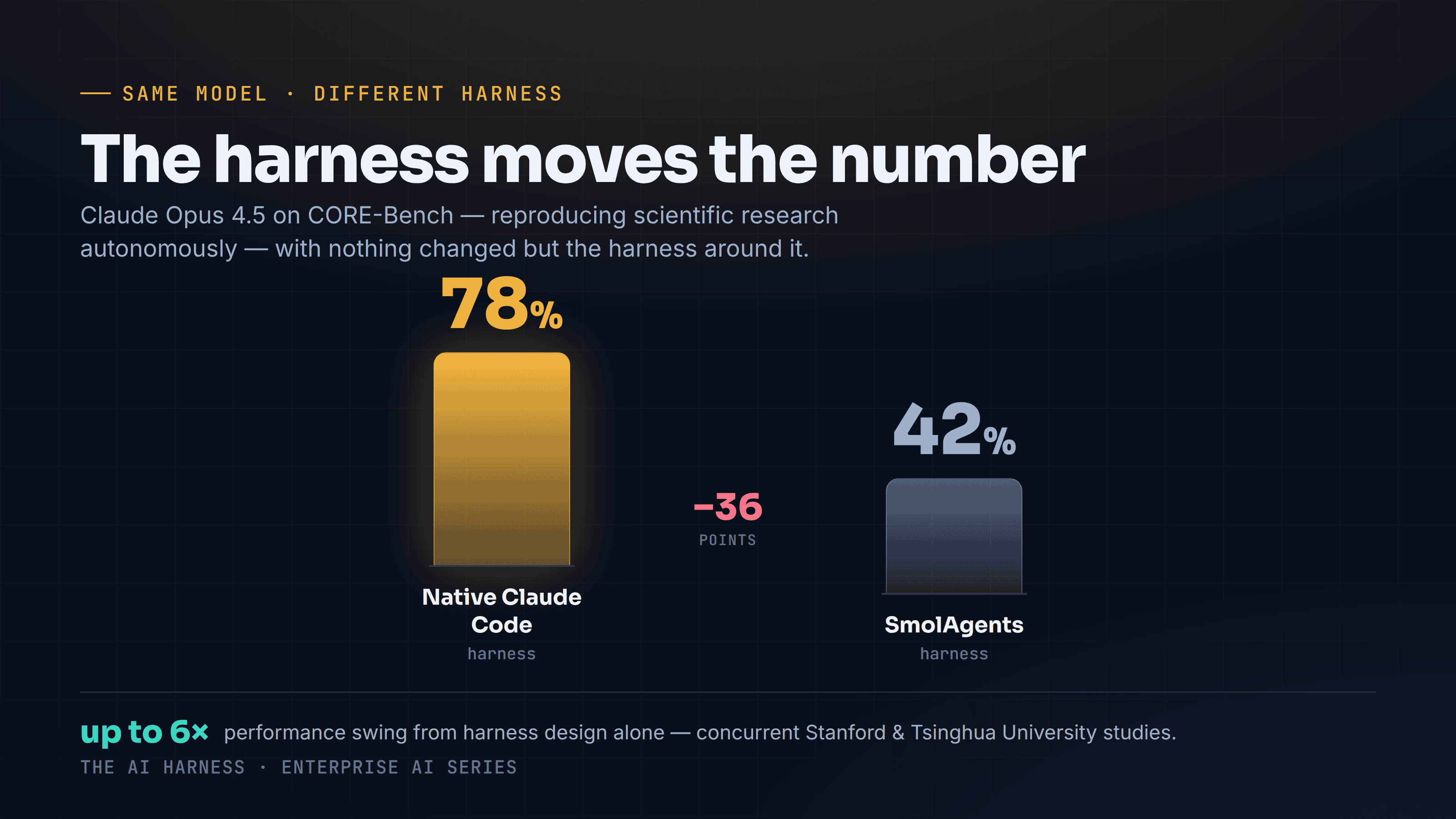
When researchers evaluated the Claude Opus 4.5 model on the CORE-Bench benchmark (an advanced AI evaluation framework designed to assess an AI agent's ability to autonomously reproduce scientific research papers), it achieved a 78% success rate inside the native Claude Code harness. But it dipped down to 42% when using HuggingFace's SmolAgents harness, a drop of 36 percentage points.
In concurrent studies by Stanford and Tsinghua University, the same model, with different harness designs, was shown to vary in performance by up to 6x.
So, as the models themselves become more capable and more interchangeable, the focus is shifting towards the harness that surrounds them. For enterprises that want to incorporate AI and especially AI agents into their workflows, customizing and improving the harness is likely to have the most significant impact.
The six building blocks of an AI harness
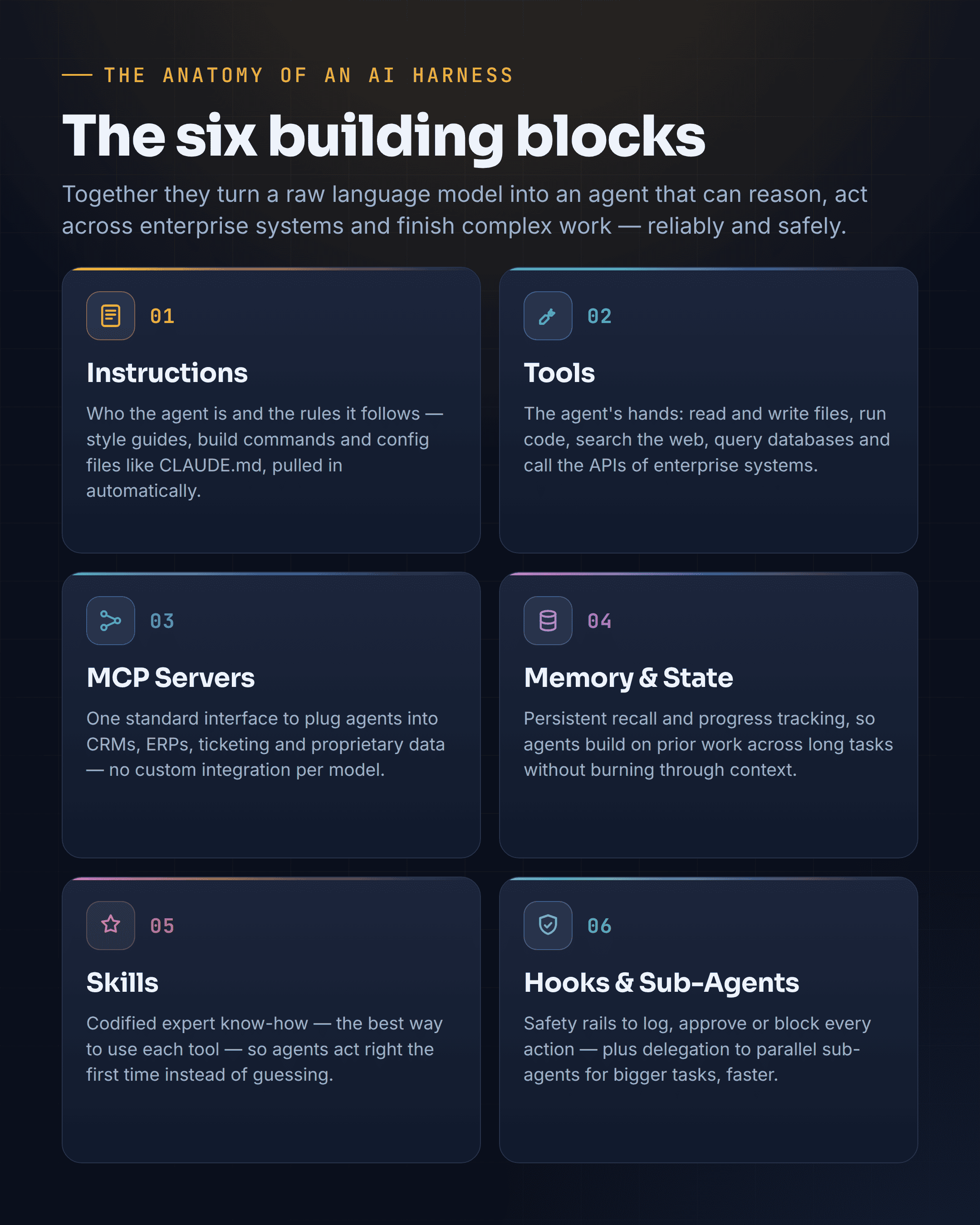
A harness has six primary components. Together, they hold the key to transforming an LLM from a conversational interface into an AI agent capable of reasoning, interacting with enterprise systems and completing complex workflows:
1. Instructions
Instructions about the agent's identity, essentially telling the agent who it is and what rules it needs to follow.
For example, for AI coding agents, it would include codebase rules, style guides and build commands. Instead of forcing a human developer to repeatedly paste this info into a chat box, the instructions would be contained in localized configuration files (Markdown files like Claude.md and Gemini.md) and placed in the root directory of a code repository.
The information in these files is like a briefing document for AI coding agents and terminal tools. The files are automatically detected and pulled into the AI's context window at the beginning of a coding session.
2. Tools
These are like the agent's hands, enabling it to interact with the outside world by reading and writing files, executing code, searching the web, querying databases, calling APIs or updating enterprise applications.
AI harnesses will typically include a set of native tools, such as file read/write operations to allow the agent to interact with the computer it's running on, shell or Bash execution to run commands and web search. Many will also include supporting connectors to enable the AI to access and use external business systems such as CRM platforms, ERP applications and ticketing systems.
The breadth and quality of the tools will determine what AI agents can accomplish. The AI harness provides a standard way to discover, access and control these capabilities, enabling agents to reliably complete complex, multi-step business tasks and workflows.
3. MCP Servers
These provide a standardized way to connect AI agents to external systems, to gather information and access capabilities within specific software applications.
Instead of requiring custom integrations for every model and application, an MCP server exposes an application's tools, data and resources through a common interface that any MCP-compatible AI agent can understand.
So MCP servers simplify the task of integrating AI with enterprise software. For example, MCP servers allow AI agents to securely access information and invoke capabilities within external applications such as CRM systems, ERP platforms, document management systems, customer support platforms and proprietary databases.
4. Memory and State
Memory and state are an AI agent's recall, providing persistent context so it can retain information and maintain continuity as it works through the steps that make up a task. They are critical to an agent's reliability and efficiency, enabling it to build on previous work and operate over extended tasks.
An AI's harness will manage multiple forms of memory, including session memory for information and instructions gathered within a single conversation, persistent memory that runs across sessions and a file system for working memory where files and outputs can be stored.
The harness also maintains the agent's 'state'. This is what the agent knows about what it is currently doing, enabling it to track its progress through tasks and workflows.
Without effective memory management, an agent would waste time and resources rediscovering information and quickly burn through its context window.
AI harnesses minimize the context used by an agent through techniques such as context compaction, selectively summarizing previous interactions and information and retaining only the most relevant points while discarding unnecessary detail. This allows the agent to retain the key information it needs for managing complex workflows without exceeding its context window.
5. Skills
Skills encompass the necessary domain expertise and reusable instructions that enable an AI agent to autonomously perform tasks within its remit as effectively as possible. They define how the agent should interact with particular applications, APIs or business systems, including which tools to use and the most effective or best way to use those tools to tackle a specific task.
Without this, the agent wastes multiple exploratory tool calls per task just figuring this out, creating delays, increasing token consumption and raising the risk of errors.
By packaging reusable skills and knowledge within the AI harness, organizations give agents optimized ways of acting that reduce unnecessary reasoning and support faster, more reliable task completion. They are a way of codifying expert knowledge once and reusing it across multiple agents and models, improving the consistency, reducing costs and making AI systems more efficient at scale.
6. Hooks and Sub-Agents
Hooks are the agent's safety rails. Hooks provide the governance layer around an AI agent's actions, allowing an organization to intercept tool calls to log what is happening, approve it or modify it.
In other words, when an agent attempts to use a tool, access data or perform an action such as updating a database or executing code, hooks are the points where the organization can log the activity for auditing, block actions that violate company policy, modify requests to remove sensitive information, or enforce security rules. They provide control over how AI agents interact with business systems.
The harness enables an AI agent to break complex tasks into smaller steps and create sub-agents to delegate them. For example, one sub-agent might research information, another analyze data, and a third prepare a presentation, before the main agent combines the results. Multiple sub-agents can work in parallel to reduce the time taken.
Sub-agents increase an agent's capabilities by enabling delegation and parallel working to complete larger, more sophisticated tasks faster and more effectively, while hooks ensure those capabilities are exercised safely and responsibly.
Smarter models alone will not guarantee AI success
The AI race is no longer only about building and employing the smartest model. Increasingly, it is about constructing the most capable harness.
As enterprises move from experimenting with AI to deploying autonomous agents at scale, the quality of the harness is likely to become one of the defining areas of competitive advantage. Gartner forecasts that by the end of 2026, 40% of enterprise applications will feature task-specific AI agents. The harnesses that direct and channel the power of the underlying AI models will significantly impact the success of those agentic implementations.